HYDRABAD RAPE CASE ARTICLE
X
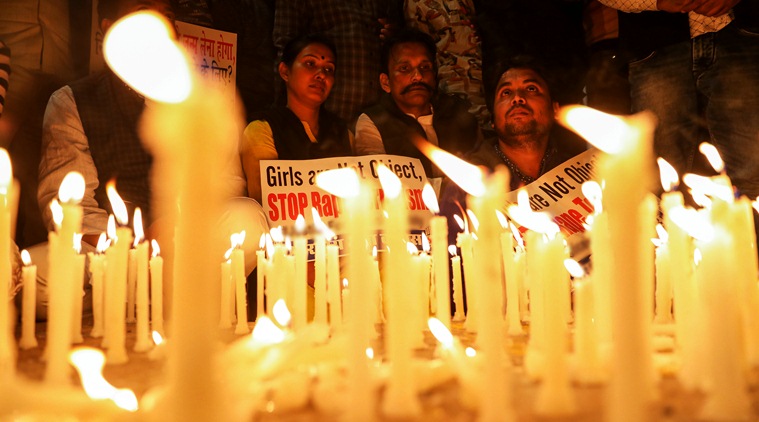
People attend a candle light march to protest against the rape and murder of a 27-year-old woman on the outskirts of Hyderabad, in New Delhi. (Reuters)
It has been seven years since the December 2012 Delhi rape case shocked the conscience of our nation. But barring some changes in the law, it seems that little has changed on the ground. Five years after the Delhi HC confirmed the death sentence against the accused, the appeals process is yet to be exhausted. Meanwhile, women continue to live with the fear of facing the full spectrum of misogyny, from leering looks to brutal violence, both at home and in public spaces.
What is doubly outrageous is the misplaced idealism, and simply stupid and perverse logic, that are offered to us for the persistence of such violent crimes. On one end of the political spectrum, structural misogyny and gender bias, embedded in our cultural norms and social practices, are frequently offered as an omnibus explanation for these brutal acts. While it contains important insights, this diagnosis is unhelpful in offering urgent practical solutions. Rape is a universal phenomenon. The fight for gender equality is a worthy goal in itself. But to think that violent rapes would go away if only all men could be equally conditioned to view women with respect and equality, is a lofty ideal. We need to be prepared for the possibility that despite the adoption of most progressive social norms and beliefs, some men at some times will continue to behave as beasts. Enlightened social values will not suffice in dealing with them. An effective criminal justice system is required.
On the other end of the spectrum, we see all kinds of bizarre explanations that blame these heinous crimes on what women wear, where they work, how they entertain themselves, and when and where they travel. Others blame their incidence on what men eat and drink, and what they watch on film and TV, and what they access on the internet. It points to our collective sense of numbness and shock, that we barely react when such absurdities are spouted as explanations.
We need to start asking hard questions and go beyond outrage, the clamour for harsher laws, and for outrageous solutions such as lynchings and public executions. Tough laws are merely the first step. We need to create well resourced and accountable systems that enforce these laws. Severity of punishment is only one aspect of an effective criminal justice system. Certainty of punishment is equally important — probably more so. If the investigating agencies and the trial courts can be made accountable for time-bound investigation and fast-track trials, the higher judiciary must also introspect about ensuring a time-bound disposal of appeals in such cases. Similar considerations must apply to the disposal of all mercy petitions.
There are critical gaps in our institutional capacity to fight crimes against women. First, we need to recruit more women at all ranks in our police. And also as prosecutors and judges. In many cases, including the Hyderabad doctor’s case, we have heard complaints about the poor quality of police response. This is both a resource issue and a culture issue. We will always be assessing the urgency and genuineness of a call and prioritising our resources accordingly. The quality of our response then becomes a culture issue. Even today, a class 10th certificate remains the minimum qualification for recruitment as a constable in many police forces. The constabulary constitutes 95 per cent of our police force. To expect someone with such rudimentary education and basic training to act as a first responder in cases of rape and violence against women, with an innate sense of sensitivity and professionalism, is wishful thinking. We need to change our recruitment and training standards to better incorporate their role in dealing with crimes against women.
On a contrarian note, despite popular perception of a country hit by a epidemic of brutal rapes, the data suggests that our incidence of rape per 1,00,000 population is quite low compared to other societies. Even if we double or triple the figures on account of under reporting, we have no reason to believe that rape in India is more pervasive than other countries. However gruesome, incidents do shock our collective conscience — as they must. But venting of outrage on social media and public protests will not solve the problem.
On many occasions, independent India has demonstrated its capability to tackle national challenges with resolve and purpose. How about a National Naari Suraksha Mission where the GoI tackles the problem in mission mode in close partnership with the state governments? It would give states grants and other incentives for improving their institutional capacity for tackling crimes against women.
If i ever ran into the parents of the December 12 victim or the Hyderabad vet, I don’t think I would be able to face them without a sense of shame and failure. We simply couldn’t do enough to prevent their daughters from becoming victims. At best, we can hope that their perpetrators will finally face justice. But I do want to be able to look my sister in the eye and tell her that we will do everything it takes, to ensure a safer India for all our women

 shubham's blog